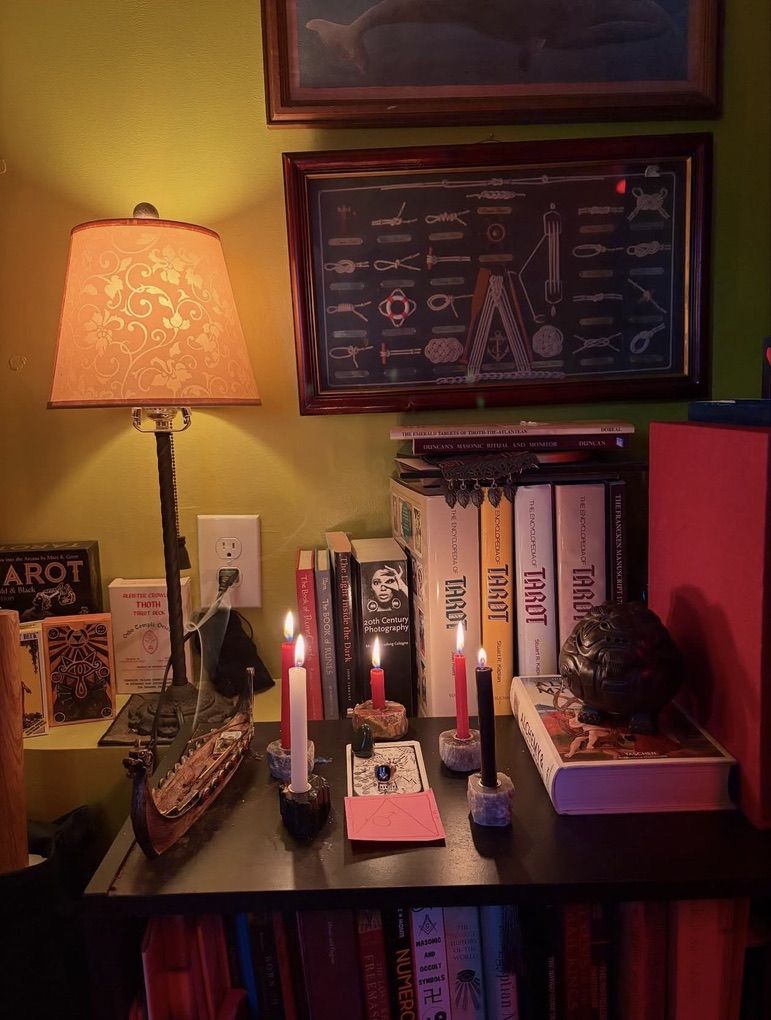
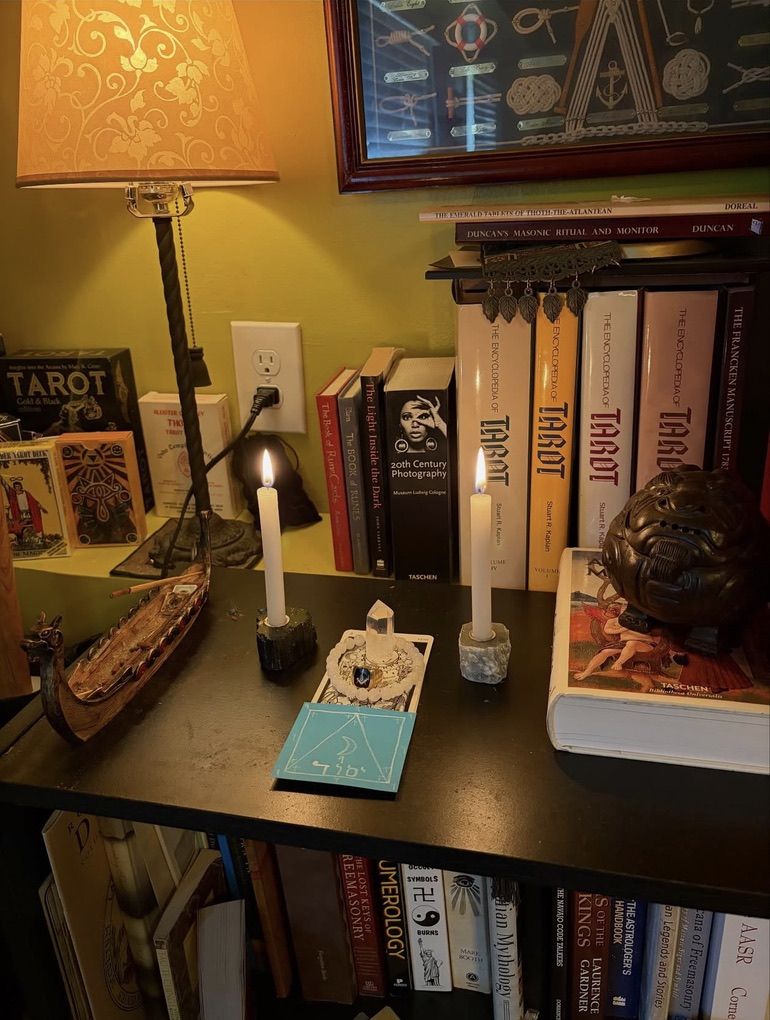
Not a shelf of things that look spiritual. A fountain.
We dive into your astrological chart, your Pythagorean numerology, the tarot, your ancestral spirituality, and the earth spirits of the land you live on, and from them we create a home altar that is not a collection of knick-knacks, but a true fountain of energies for you and your home.
In most homes, an altar is a shelf where spiritual-looking things accumulate: crystals, statues, candles, a deck of cards, a stick of incense. It may be beautiful. It is rarely alive. Nothing on it was chosen for a reason, and nothing about it answers to the person who keeps it.
A true altar is a center. It is the point in a home where the household meets the unseen, built according to correspondence, oriented with intention, consecrated, and kept. In the old traditions an altar was never decoration. It was the hearth of the spiritual life of the house, and everything else in the home was ordered around it.
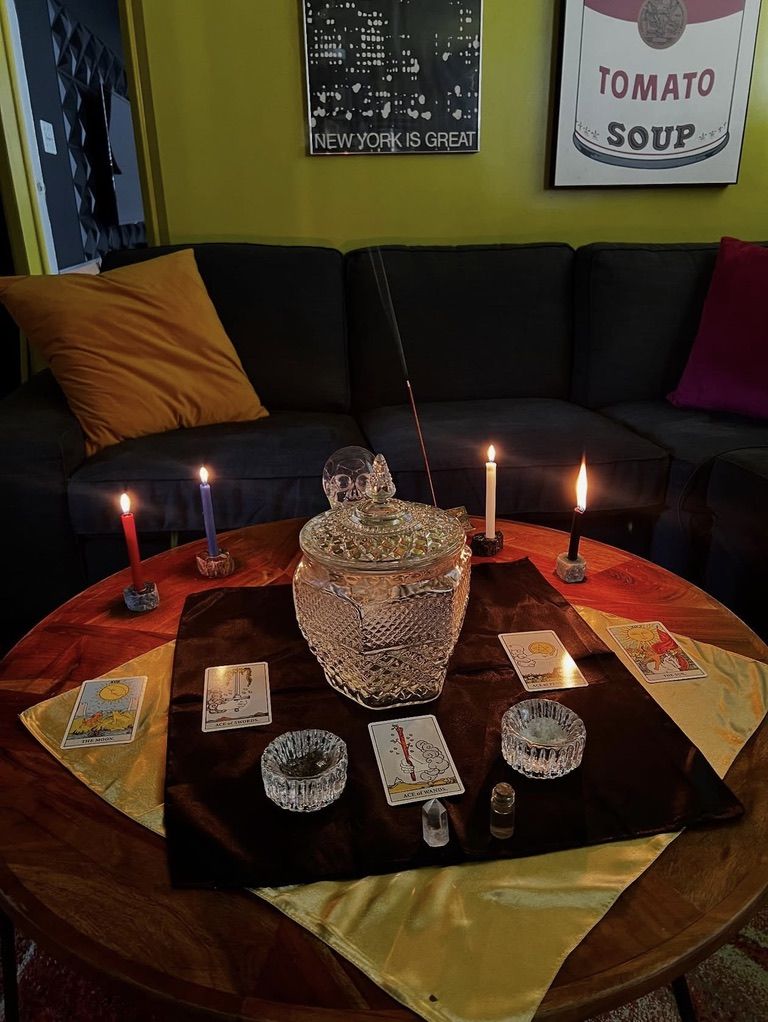
A working altar: elemental lights and a sigil at the center.Four lights for four elements, the Sun and Moon to either side.
The Five Sources
Your altar is built from five sources, read together, so that what stands on it belongs to you and to the place where you live.
IYour astrological chart. The planets strong and weak in your nativity, your rising sign, and your ruling powers tell us which forces the altar should honor and strengthen, and with them the colors, metals, days, and hours proper to its keeping.
IIPythagorean numerology. Your core numbers govern proportion and arrangement: how many lights, how the objects are set in relation to one another, and the geometry that holds the whole together.
IIIThe tarot. A reading reveals what your life is asking of the altar now, which currents it should support, which it should guard against, and which cards may stand upon it.
IVAncestral spirituality. Your lineage, your honored dead, and the faith and customs you descend from. An altar that forgets where you came from is missing its roots.
VThe spirits of the land. The ground your home stands on has its own presence, its waters, stones, and history. We learn the place and give it its due, so the altar is rooted where it actually stands.
How the Work Proceeds
Consultation. We discuss your home, your practice, your faith and family, and what you want the altar to do.
Diagnosis. I erect and read your natal chart, calculate your numbers, conduct a tarot reading for the altar, and study your lineage and the land where you live.
Design. You receive a written altar plan: its placement and direction, its layout and geometry, what belongs on it and why, what to remove, and the materials, colors, and correspondences proper to it.
Assembly. The altar is built, either with me on-site in New Jersey or by you at home following the plan, by arrangement.
Consecration. The finished altar is consecrated to its purpose, so it begins its life as a working center rather than a display.
Keeping. You receive a simple practice for tending it: when to light it, what to offer, which days and hours suit it, and how to renew it over time.
Every object answers to something. Everything that does not, is left out.
Investment
Because every altar is built to the person and the home, Altar Creation is quoted after an initial consultation, according to the depth of the diagnosis, whether the work is on-site or remote, and whether consecration is performed in person. Inquire about an altar →
The altar does not hold power because of what is placed upon it. It holds power because of what it answers to.The Working Principle
Frequently Asked Questions
Is this just a decorated shelf?
No, and that is the entire point. Most home altars are assembled from things that look spiritual: a crystal here, a statue there, a candle that smelled nice in the store. An altar built this way has no center, no orientation, and no reason. The altars I design begin from you: your chart, your numbers, your lineage, the land under your house. Every object is there because it answers to something, and everything that does not belong is left out.
Do I need to buy a lot of expensive items?
Usually not. Many people already own what the altar needs and simply have it in the wrong place, in the wrong arrangement, or mixed with things that work against it. The design will tell you what to keep, what to add, and what to remove. Where something must be acquired, I will tell you what it is, why it matters, and what a reasonable version of it looks like.
Does the altar have to follow your tradition, or can it honor mine?
It honors yours. The method comes from the Western Mystery Tradition, but the altar is built for the person who will keep it. If your family is Catholic, Orthodox, Jewish, Protestant, or something older, that current is part of what we work with. Ancestral spirituality is one of the five sources for exactly this reason.
What are the spirits of the land, and why do they matter?
Every place has its own presence: the old Romans called it the genius loci, the spirit of the place. The ground your home stands on has a history, waters, stones, and a character of its own, and an altar that ignores where it stands is only half rooted. Part of the work is learning that place and giving it its proper due, so your home is in right relationship with the land it sits on.
How much space do I need?
Less than you think. A proper altar can be a shelf, a tabletop, a corner of a room, or a dedicated space, depending on your home and your practice. The design accounts for the space you actually have, including direction, light, and how the room is used.
What happens after the altar is built?
An altar is not a display. It is a living thing that must be kept. You receive a simple practice for tending it: when to light it, what to offer and when, which days and hours suit it best, and how to refresh it over time. Kept properly, it becomes a steady source of power in your home rather than a collection that gathers dust.